Skip to content
TACTICALOEM / ODM TACTICAL APPAREL
ENEnglish

Products / Camouflage Uniforms

Custom Camouflage Uniform Manufacturer

On a camouflage uniform, the print is the product. Buyers rarely reject a camouflage garment because of the stitching; they reject it because the pattern repeat lands badly on a small panel, because the shirt and trouser came from print lots that read as two different colours in daylight, or because the scale of the print makes the garment look wrong at the distance the end user is normally seen. All three are print and cutting decisions, not sewing decisions, and none of them can be fixed after the fabric has been printed. This page covers what a B2B buyer has to settle before a camouflage programme starts: the source and ownership of the artwork, print method and repeat scale, how a pattern behaves on small panels against large ones, shade control between print lots and between the two pieces of a set, base fabric selection, reinforcement, size development, private label, sampling and bulk production.

custom camouflage uniformscamo uniform OEMwholesale camouflage uniformscamouflage uniform supplier
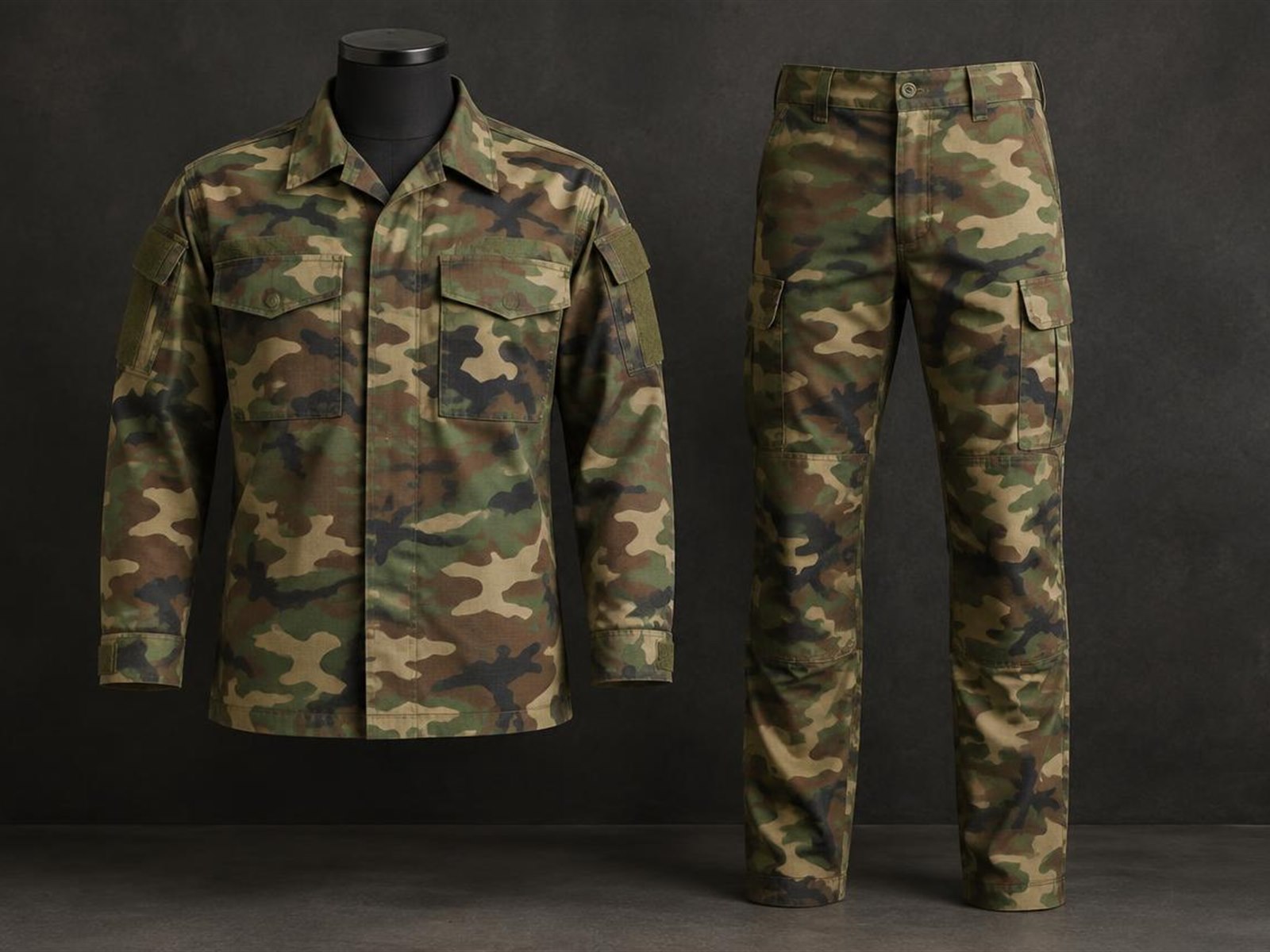
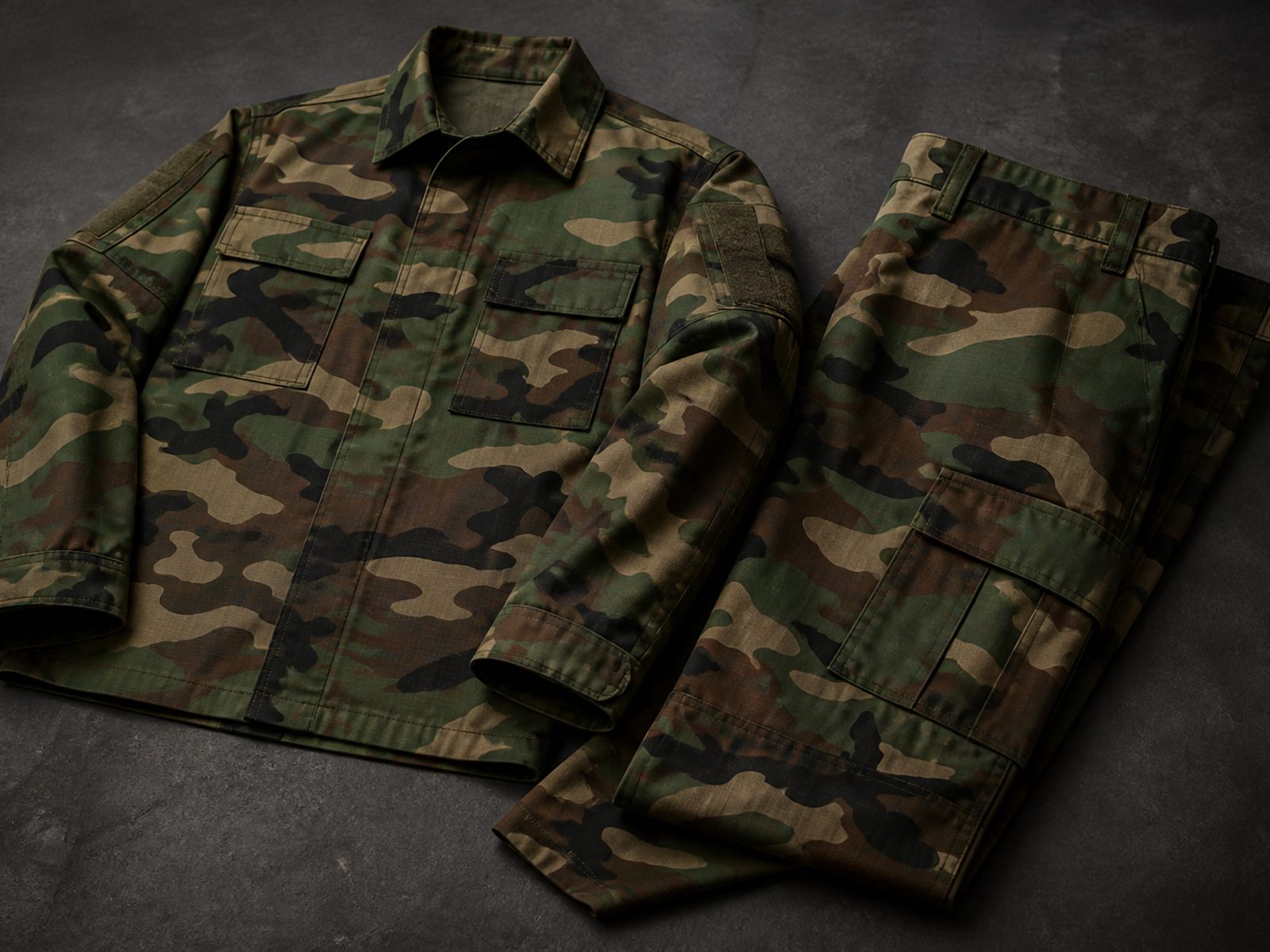
Custom camouflage uniform set printed to buyer artwork manufactured for OEM buyers
Primary keyword
camouflage uniform manufacturer
Climate focus
Temperate / Woodland / Mixed Vegetation · Desert / Arid / Semi-Arid · All Season / Multi-Environment
Development input
Tech pack · Reference sample · Sketch · Photo
Camouflage UniformsCamouflage UniformsCamouflage UniformsCamouflage Uniforms

Buyers

Who buys camouflage uniforms?

Camouflage Uniforms is specified by organisations rather than bought as a single garment, so a quotation has to satisfy all 6 buyer profiles listed below.

Tactical Brands

A supplier who can hold a signature camouflage print and scale across repeat orders without the pattern shifting in tone or repeat between production runs.

Outdoor, Hunting & Shooting Brands

Camouflage printed to their own artwork or seasonal pattern, on a base fabric chosen for civilian comfort rather than military abrasion specification.

Uniform Distributors & Wholesalers

Matched shirt and trouser volume in a stable shade, with documented print and colour standards so reorders match stock they already hold.

Security & Facility Management Companies

Camouflage or subdued solid uniforms with insignia application, plus print consistency that keeps a mixed workforce looking identical after repeat laundering.

Government Contractors & Procurement Companies

Full print specification transparency, artwork ownership clarity, pre-production sample approval and inspection records before shipment.

Private Label Brands & Importers

Buyer artwork camouflage with their own labels, hangtags and retail packaging on a garment they can present as their own design.

Types

Camouflage Uniforms types

The same category name covers very different garments depending on climate and wear pattern. 3 types of Camouflage Uniforms are covered here, and the type is chosen before the fabric.

Temperate / Woodland / Mixed Vegetation

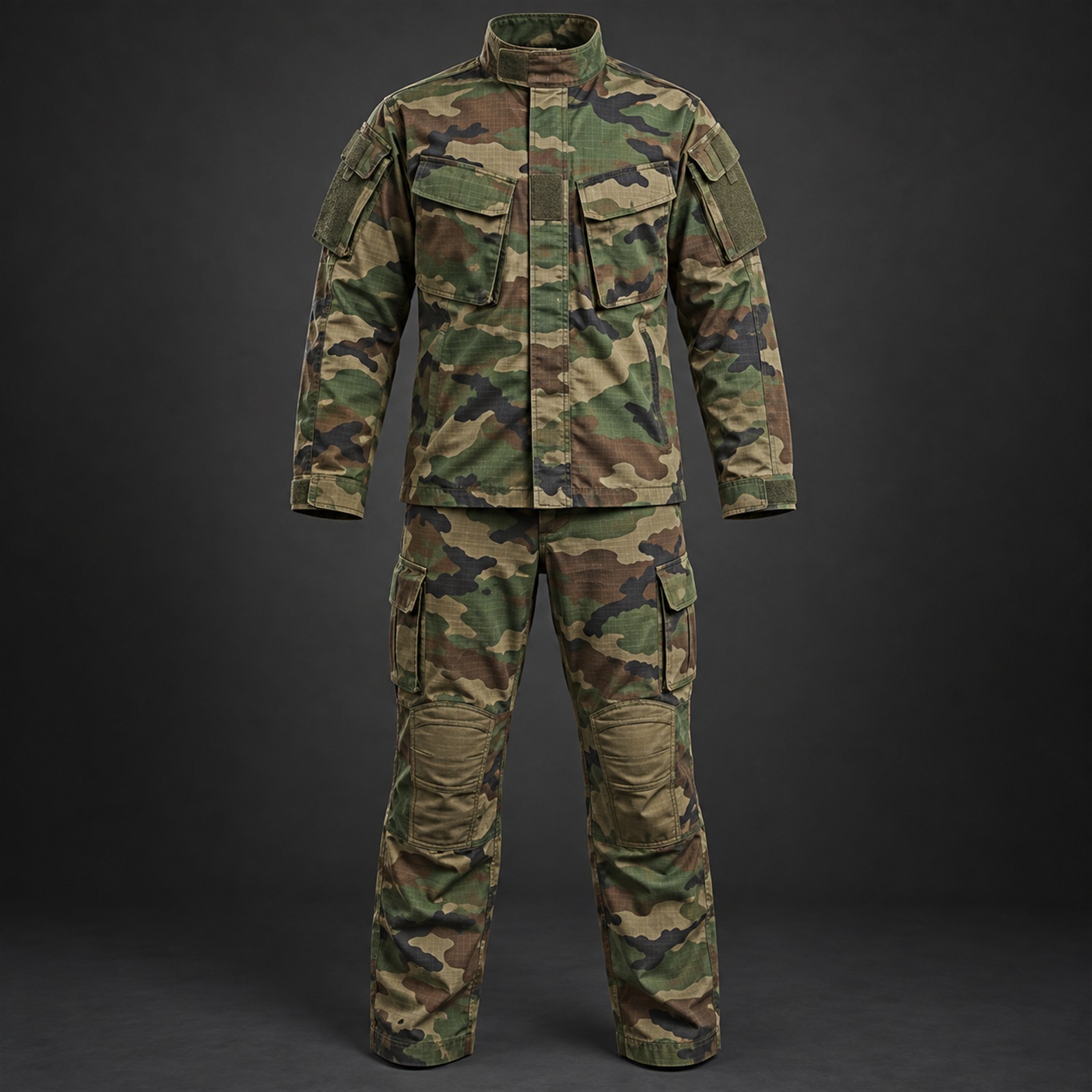
Woodland & Temperate Camouflage Uniform

A multi-tone print with higher contrast between colours, intended to break up the silhouette against mixed foliage and shadow. The print problem here is contrast control: if the darkest tone prints too dark, the garment reads as a solid block at distance, which defeats the purpose of the pattern.

  • Multi-tone woodland or temperate print
  • Controlled contrast between light and dark tones
  • Ripstop base fabric for abrasion resistance
  • Matched shirt and trouser from the same print lot
  • Reinforced knee, seat and elbow for field wear
Desert / Arid / Semi-Arid

Desert & Arid Camouflage Uniform

A lighter, lower-contrast print built around sand, tan and brown tones. Desert prints are sensitive to small colour differences because the tonal range is narrow, so shade control between lots is harder to hold than on a high-contrast woodland print and has to be managed as a print standard rather than per garment.

  • Low-contrast sand and tan tonal print
  • Print standard approved before bulk
  • Lightweight base fabric for heat load
  • Reduced panel count to limit heat build-up
  • Dust-tolerant reinforcement at knee and hem

All Season / Multi-Environment

Digital & Multi-Environment Camouflage Uniform

A pixel-based print with small pattern elements, often intended to work across more than one environment by combining several tonal scales in one design. Digitised pattern elements are harder to reproduce consistently because small elements are more sensitive to print resolution, fabric surface and the direction the panel is cut in.

  • Pixel or multi-scale pattern elements
  • Pattern scale verified on small panels
  • Consistent cut direction for directional prints
  • Base fabric matched to the intended season
  • Print resolution and alignment checked on incoming fabric

Engineering

Construction, part by part

8 construction decisions define Camouflage Uniforms, and each row below is one decision you control at specification stage.

Camouflage Print

  • Buyer-supplied artwork
  • Buyer artwork redrawn to a print-ready file
  • Woodland style
  • Desert style
  • Digital or pixel style
  • Custom seasonal pattern

Before printing starts, the buyer needs to confirm who owns the artwork and whether it is an original design or derived from an existing pattern. The pattern repeat size and the number of colour ways must also be fixed, because both change the print set-up and the cost of a re-run.

Panel Placement & Alignment

  • Print repeat positioned per panel
  • Directional print cut in one direction
  • Mirror-matched front panels
  • Random placement for non-directional prints
  • Continuity across the shirt placket and trouser fly

This is where a print is won or lost. A large repeat cannot be judged from a swatch; it has to be assessed on the smallest panel of the smallest size. Buyers should state whether the print is directional, because that determines whether panels can be nested freely or must be cut in a fixed direction.

Shirt Construction

  • Two-material torso with printed ripstop sleeves
  • Single-fabric printed shirt
  • Zip-front shirt
  • Button placket shirt
  • Stand or zip-through collar with chin guard

Where the torso uses a plain colour under a printed sleeve, the buyer is making a deliberate choice to reduce print consumption and weight. Where the whole shirt is printed, print lot consumption and shade control become more critical because the same fabric must cover every panel.

Sleeve & Elbow

  • Printed ripstop sleeve
  • Flat reinforced elbow patch
  • Internal or external elbow pad pocket
  • Hook and loop insignia panel on the sleeve
  • Roll-up sleeve tab

Elbow reinforcement on a printed sleeve has to be positioned so the print still reads correctly across the panel, otherwise the overlay looks like a patch applied to a different garment.

Trouser Body & Crotch

  • Printed ripstop body
  • Diamond gusset
  • Two-panel gusset
  • Stretch gusset insert in matched shade
  • Reinforced seat panel

A stretch gusset is often a different fabric construction from the printed body, so a matching shade has to be approved separately. A gusset that reads as a different tone than the printed body becomes visible the moment the user kneels.

Trouser Knee

  • Articulated knee dart
  • Printed reinforcement overlay
  • Abrasion-resistant overlay in a matched tone
  • Internal or external knee pad pocket
  • Unreinforced knee for lightweight builds

Knee overlays are usually a plain or differently constructed fabric. The tone chosen for the overlay determines whether it disappears into the print or draws attention to the knee, and buyers should decide that deliberately.

Waistband & Fly

  • Rigid waistband with belt loops
  • Partial elastic side inserts
  • Full elastic back waistband
  • Zip fly with button closure
  • Zip fly with hook and loop

Waistband hardware and elastic are supplied in plain tones rather than printed, so the colour has to be matched to the print rather than to a solid fabric. This is a common source of visible mismatch on camouflage garments.

Pockets & Hardware

  • Printed or plain chest pockets
  • Sleeve pocket with zip or flap
  • Printed thigh cargo pockets
  • Reinforced tool or knife pocket
  • Matching hook and loop in subdued tones
  • Thread colour matched to the print

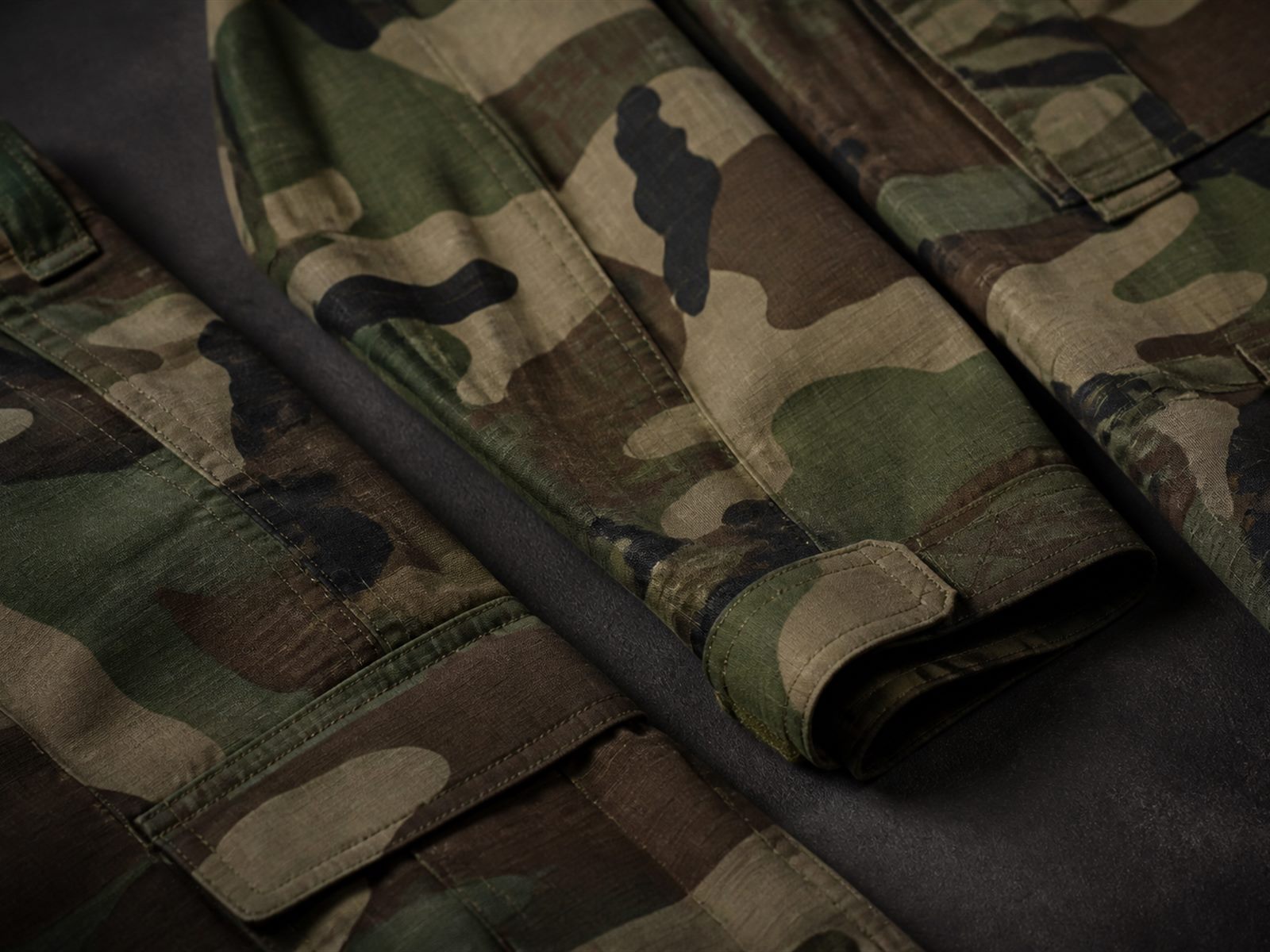
Thread, zip tape, hook and loop and elastic are all supplied in plain colours, and on a multicolour print each one is a decision. Buyers should confirm the intended tone against the print under daylight rather than on screen.

Available fabrics

Material options by garment area

Base Fabrics

Poly cotton ripstopNYCO ripstopCotton ripstopStretch ripstopLightweight hot weather fabric

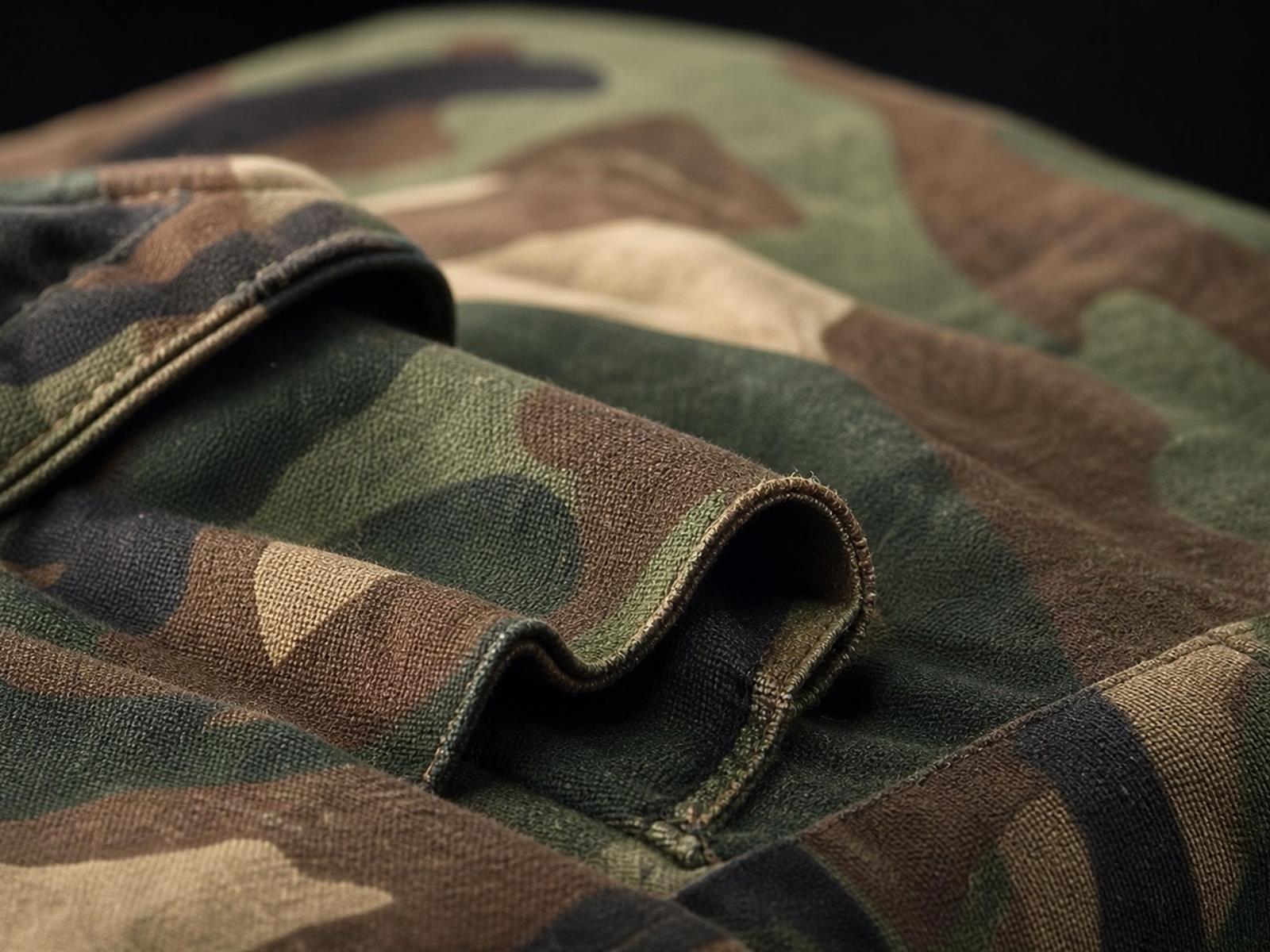
The base fabric determines how the print takes and how it holds. A smooth, tightly woven surface reproduces fine pattern elements more faithfully than a fabric with a pronounced texture, while NYCO is generally selected where abrasion resistance and dimensional stability matter most. Composition and weight are confirmed per programme.

Reinforcement Panels

Printed self-fabric overlayAbrasion-resistant overlay in a matched plain toneDouble-layer printed self fabricStretch panel in matched shade

Self-fabric overlays keep the print continuous but consume more print lot; plain overlays use less printed fabric but introduce a second tone that must be matched against the print.

Lining, Elastic & Trims

Subdued elastic in coordinated tonesPlain zip tape matched to the printCoordinated thread shadesPlain hook and loop in subdued tonesMesh or plain pocket lining where specified

Trims are never printed, so every trim item is a colour decision against a multicolour pattern. Approving them as a set on the print sample avoids piecemeal mismatch that only becomes obvious on finished garments.

Customization

What can be customized

15 specification lines are available for Camouflage Uniforms, and where an option changes cost, weight or durability the consequence is stated next to it.

Camouflage Pattern

Buyer artworkRedrawn print-ready artworkWoodland styleDesert styleDigital styleCustom seasonal pattern

Pattern Scale

Small scale for compact panelsMedium scaleLarge scaleMulti-scale within one patternBuyer-specified repeat size

Base Fabric

Ripstop familyStretch ripstopLightweight hot weather fabricBuyer-specified composition

Set Composition

Shirt and trouserShirt, trouser and jacketTrouser onlyShirt onlyBuyer-defined piece combination

Color

Buyer Pantone targets for tonal referencesBuyer lab dip approvalPrint standard approval before bulkSubdued solid colorways

Shirt Style

Two-material combat styleSingle-fabric printed field shirtZip-frontButton placketShort sleeve variant

Trouser Style

Straight leg field trouserCargo trouserTapered duty trouserConvertible or roll-up leg

Collar

StandZip-through with chin guardFold-down field collar

Knee & Elbow

Printed self-fabric reinforcementPlain tone abrasion overlayInternal pad pocketExternal pad pocketArticulation onlyNone

Pocket Layout

Chest pocketsSleeve pocketCargo pocketsTool or knife pocketInterior document pocket

Waistband & Fly

Rigid with belt loopsSide elasticFull elastic backZip with buttonZip with hook and loop

Trim Color Matching

Thread matched to print tonesZip tape matched to print tonesHook and loop in subdued tonesElastic in coordinated tones

Insignia & Branding Position

Shoulder panelsSleeve panelsChest logoTrouser thigh logoSubdued embroidery or patch

Label

Main labelSize labelCare labelCountry of origin label

Packaging

Poly bagPrinted poly bagHangtagHeader cardCustom boxSet packed as one unit

Sizing

Size development

Size development on a camouflage uniform starts from the measurements the end user is issued and from the smallest panel that has to carry the print. Before a size set is built we need the buyer's target size range, either body measurements or garment measurements from a reference set, the pairing rule between shirt and trouser sizes, and any sizing system the buyer already sells. From there we build a size set sample so critical measurements can be checked across the range rather than only in the middle size: chest, shoulder, sleeve length and back length on the shirt; waist relaxed and stretched, hip, rise, thigh, knee position, inseam and leg opening on the trouser. Knee position and pocket depth are also checked against the print repeat, because a pattern that reads correctly on a large panel can look wrong when it is cut down to a small pocket flap or a short sleeve. Measurement tolerance is agreed in writing for each piece before bulk.

How size development works

Branding

Private label

Private label on a camouflage programme includes the print itself, which is often the most valuable asset in the relationship. Where the buyer supplies original artwork, ownership and the terms for reuse across suppliers should be agreed in writing before printing starts. On the garment side, main label, size label, care label and country of origin label are produced to the buyer's artwork and content requirements, and branding can be applied as woven label, printed label, rubber patch, subdued embroidery or heat transfer, with insignia positions agreed on the pattern for every size. Packaging can be as simple as a poly bag or as complete as a printed poly bag with hangtag, header card and custom box, or a set packed as one retail unit.

Customization capability

Development

Sampling process

Sampling for Camouflage Uniforms runs in 8 stages, each one removing a specific risk before the next stage commits cost.

01

Artwork and requirement review

We review the buyer's artwork file, tech pack, reference garment or photo and list every open specification before any fabric is printed —including repeat size, colour direction, print direction and artwork ownership.

02

Print direction and repeat planning

The repeat is planned against the actual panel sizes of the smallest and largest garments in the range so the pattern reads correctly on a pocket flap as well as on a back panel.

03

Base fabric selection

Base fabrics are proposed against the intended climate and abrasion requirement, with alternatives supplied where a specification is not yet fixed, since the fabric surface affects how the print reproduces.

04

Print trial

A print trial on the proposed base fabric is produced so the buyer can assess tone, contrast and pattern scale on real fabric rather than on a digital proof or a screen.

05

Prototype garment

A first sample is produced in the trial print so the buyer can judge how the pattern lands across seams, pockets and the placket in a finished garment.

06

Revision

Buyer comments on print and construction are consolidated into a single revision round so the specification converges instead of drifting.

07

Size set

The full size range is produced for measurement confirmation, with the print checked on the smallest panels of the smallest size.

08

Pre-production sample

The approved print standard, construction, materials and labelling are locked in a pre-production sample that becomes the bulk standard.

Production

Bulk manufacturing

Bulk production of Camouflage Uniforms runs in 7 stages, which is where an approved specification is either held or lost.

01

Print standard and trim approval

The print standard, base fabric, zips, hook and loop, elastic, thread and labels are approved against the pre-production sample before bulk printing.

02

Bulk printing

Printing runs under controlled conditions against the approved standard, with the print direction and repeat recorded so a re-run can be reproduced.

03

Incoming printed fabric inspection

Printed fabric is checked on receipt for tone, contrast, repeat alignment and print defects before it is released to cutting.

04

Lot grouping and shade banding

Rolls are grouped by print lot and shade band so panels from visibly different lots are not combined within one garment or between a shirt and its matching trouser.

05

Bulk cutting

Cutting follows the approved markers with direction-sensitive prints nested so all panels of a garment run the same way.

06

Assembly

Assembly follows the approved construction sequence, with reinforcement, print alignment and trim tone controlled as specified.

07

Final inspection and packing

Print appearance, measurement, construction and packing are inspected against the agreed standard, and shirt and trouser are compared for shade before a set is packed.

Quality Control

Quality control for this category

Inspection of Camouflage Uniforms is measured against an agreed standard, and the 7 checks below are listed with what each one is measured against.

01

Artwork and print standard approval

The artwork file, print direction and approved standard are documented before production so the reference for inspection is unambiguous.

02

Incoming printed fabric inspection

Fabric is checked for print tone, contrast, repeat alignment, print registration and surface defects against the approved standard.

03

Trim tone check

Thread, zip tape, hook and loop and elastic are checked against the print under the same lighting condition used for approval.

04

Pre-production approval

The pre-production sample is approved by the buyer and becomes the reference standard for bulk.

05

Inline inspection

Work in progress is inspected at defined points, with particular attention to the crotch, knee, collar and cuff and to print alignment across seams.

06

Measurement inspection

Critical measurements are measured against the approved size set with agreed tolerances, and the pairing rule between shirt and trouser sizes is verified.

07

Final and packing inspection

A final inspection is carried out on finished goods against the approved print and construction standard, and label content, folding, bagging and carton marking are checked against the packing instruction.

Choosing a Camouflage Uniforms manufacturer

How to choose a camouflage uniforms manufacturer

The 6 questions buyers ask about Camouflage Uniforms before committing to a first order.

Settle who owns the artwork before anything is printed

The camouflage design is usually the most valuable asset in a camouflage programme. Agree in writing whether the artwork is original, who owns it, and what happens to the print files and screens if the relationship ends or if you move the programme to another supplier. A supplier who will not put this in writing is a risk to your product, not just to your schedule.

Judge the print on a garment, never on a swatch

A print repeat that looks right on a metre of fabric can look entirely different once it is cut into a sleeve, a pocket flap and a collar. Ask to see the pattern on a finished sample in every size you intend to sell, and look specifically at the smallest panels, because that is where scale problems show up first.

Ask how print lots are banded and how a mismatch is handled

Printed fabric varies between lots even when the standard is met, so the practical question is not whether variation exists but how it is managed. Ask how rolls are banded, whether a shirt and its matching trouser are cut from the same lot, and what the supplier does when a lot does not match the approved standard.

Confirm the print direction in writing

Directional prints cannot be nested freely and consume more fabric than non-directional ones, which affects both cost and how panels are cut. Confirm whether your pattern is directional and whether all panels of a garment must run the same way, so that the sampling cost and the bulk cost are calculated on the same assumption.

Decide deliberately what the reinforcement will look like

Knee, seat and elbow reinforcement is usually a plain or differently constructed fabric, so it is a visual decision as much as a durability one. Choose between printed self-fabric that keeps the pattern continuous and a plain overlay that uses less printed fabric, and approve the tone against the print under daylight.

Agree the inspection standard before bulk

Print tone, contrast, repeat alignment, trim tone and measurement tolerances should all be in writing with an agreed AQL level before bulk starts. On camouflage garments the claim is more often about appearance than about a defect, so the appearance standard needs to be as documented as the construction standard.

Products

Camouflage Uniforms products

Each product in Camouflage Uniforms is a developed specification with its own material options, construction detail and customization map.

Camouflage Uniforms

Camouflage Uniform Set

A camouflage uniform set is judged on the print before it is judged on anything else.

TemperateTropical / HumidVariable / layered use
View product

FAQ

Camouflage Uniforms FAQ

Can you print a camouflage pattern from our own artwork?

Yes. Send the artwork file and state whether it is an original design or derived from an existing pattern, along with the intended repeat size and the tonal references you want matched. If the file is not print-ready we can have it redrawn, and a print trial on the proposed base fabric lets you judge the result before garments are made.

Why does our camouflage look different on a finished garment than on screen?

A screen is a backlit image and fabric is not. Colour reproduction is also affected by the base fabric surface, the print method and the lighting the garment is judged in. This is why a print trial on the actual proposed fabric, assessed in daylight, is part of sampling rather than an optional step.

How do you keep the shirt and trouser matching?

By approving one print standard for both pieces, cutting from a single print lot wherever practical, banding rolls by shade where it is not, and comparing each finished shirt against its corresponding trouser before packing. Piece-level inspection alone does not catch a shade difference between the top and the bottom.

Can the pattern be scaled up or down for different markets?

Yes, if the artwork is vector-based or can be redrawn. Scale affects the number of colour ways and the print set-up, and it also changes how the pattern reads on small panels, so any change in scale should be re-trialled on the intended base fabric rather than applied without a sample.

Do you supply camouflage fabric on its own?

Printed fabric sourcing is part of the material sourcing we handle for a garment programme. Where a buyer wants fabric only, the same questions apply —base construction, repeat size, print direction, lot banding and the approved print standard —and a print trial is still the practical way to confirm the result.

What information do you need for a quotation?

Artwork file or pattern direction, base fabric preference, set composition, target quantity, colour or tonal references, required features such as pad pockets and reinforcement, size range, labelling and packaging requirements, and the target market and climate. A reference garment, photo or tech pack helps most. Where a figure such as MOQ or lead time has not been confirmed with you, we will state that explicitly rather than quote a number we cannot hold.

Request a Manufacturing Assessment

Send us your tech pack, reference sample or product idea. We review your requirement, recommend materials and construction, and come back with a development plan you can act on.