Capability
Tactical Apparel Customization and Private Label
Customization in tactical apparel is not a single option list. It is a set of decisions at defined points on the garment, and each decision has a manufacturing consequence. Changing a zipper changes the seam allowance, the needle and the stitch specification. Adding a pad pocket changes the pattern, the marker and the assembly sequence. Moving a logo from sleeve to chest changes the embroidery programme and the stabiliser. This is why customization is handled as a controlled change list: the point on the garment, the options available at that point, the consequence of choosing each option, and the point before production at which the decision must be finalised. Options confirmed after cutting has started cannot be absorbed without re-cutting, so the change list is closed and signed before bulk begins.
- Process steps
- 8 defined stages
- Deliverables
- 8 documented outputs
- Inputs required
- 8 from the buyer
Gallery
Customization in practice
Inputs
What we need from you
The 8 inputs development of Customization needs from you, and where one is missing we will tell you it is missing rather than assume it.
- The base product or category the customization will be applied to
- Which points on the garment the buyer wants to control, and which should stay as standard
- Fabric preference or a nominated fabric, with the intended climate and wear pattern
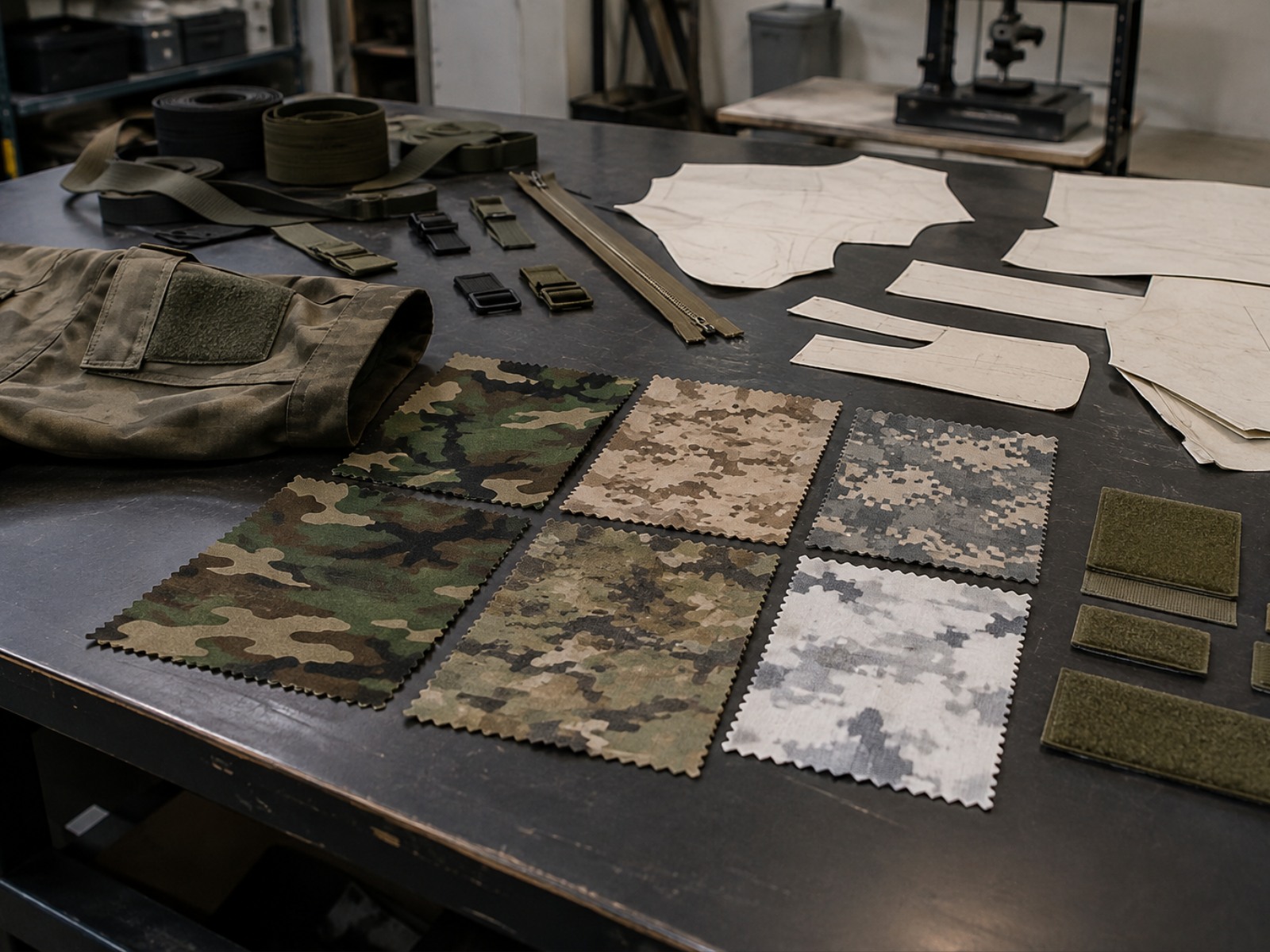
- Colour standard and camouflage pattern artwork or reference for print and yarn-dye routes
- Logo artwork in a usable vector format, with the intended placement and method
- Label requirements: brand label, size label, care label content and language
- Packaging requirement: polybag, hangtag, carton marking and any retail-ready configuration
- Any private label restriction, such as a requirement that our own branding is absent
Deliverables
What you receive
The 8 tangible outputs you receive from Customization — not assurances.
- Customization point list with available options and stated consequences
- Confirmed fabric, colour standard and camouflage strike-off approved against artwork
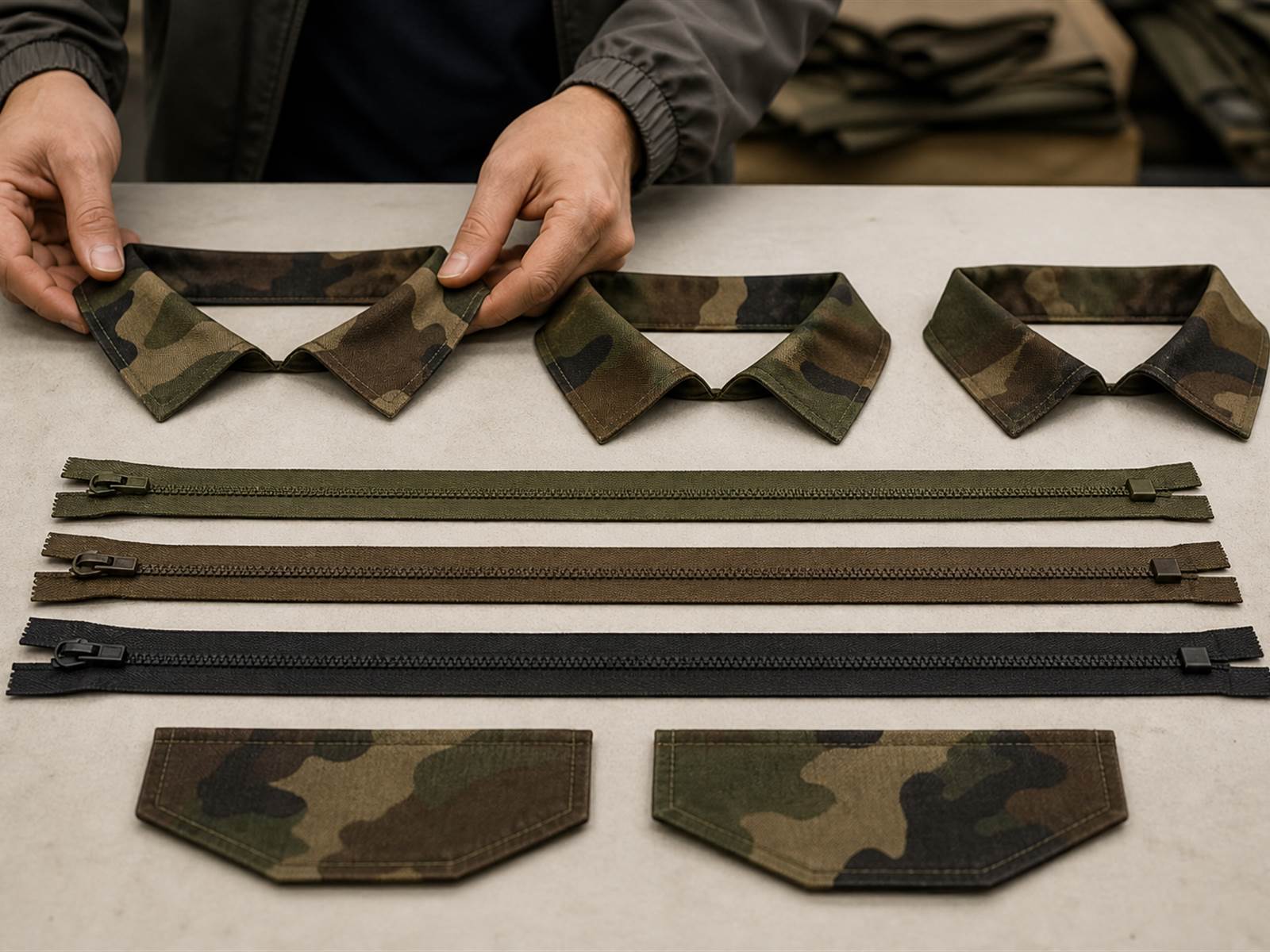
- Written construction specification for collar, pocket, zipper, hook and loop, sleeve, cuff, elbow and knee
- Hardware and reinforcement specification with colour and function recorded
- Logo strike-off and approved label proofs, including care label content
- Physical packing sample with carton marking confirmed
- Closed and signed customization change list
- Retained approval set: strike-offs, hardware, labels and packing sample
Process
The process, step by step
Customization runs as 8 steps, and the sequence is not administrative: each step removes a specific risk before the next one commits cost.
Customization point review
The garment is broken into its customization points and each one is written up with the available options and the manufacturing consequence of each. Points the buyer does not need to control are identified as well, because standardising an unimportant point reduces cost without reducing the buyer's product.
Fabric, colour and camouflage confirmation
Fabric is confirmed against the intended climate and use, colour is confirmed against a physical standard, and camouflage is confirmed against the buyer's pattern artwork with the print or yarn-dye route and repeat stated. The approved strike-off or yarn-dyed swatch becomes the standard bulk is compared against.
Construction point customization
Collar type and stand height, pocket type, position, depth and closure, zipper type and pull, hook and loop placement and grade, sleeve length and cuff closure, elbow reinforcement, knee reinforcement and any pad pocket are each specified as a dimension and a construction, not as a description.
Hardware and reinforcement specification
Zippers, hook and loop, webbing, cord, elastic, bartack and box-X positions and reinforcement fabric are specified with the colour, size and function recorded. Hardware is checked for colour match and wash behaviour against the shell, because mismatched hardware is visible on every unit of the order.
Branding specification
Logo is specified by placement, size, method and thread colour, with an embroidery or print strike-off produced for approval. Labels are specified by content, language, placement and method of attachment, including the care label text that the buyer's market requires.
Packaging specification
Polybag, size sticker, hangtag, folding method and carton marking are specified and confirmed against a physical packing sample. Packing is the last step in the chain and the first thing the buyer's customer sees, so it is specified before production rather than improvised at the end.
Change list closure
The complete customization list is issued as a controlled document with the decision deadline for each item. Items confirmed after cutting cannot be absorbed without re-cutting, so the closure point is stated in writing rather than assumed.
Approval and standard retention
Approved strike-offs, hardware samples, label proofs and the packing sample are retained with the sealed approval sample. These retained items are what incoming and final inspection are checked against on this order and on the next one.
Buyer value
Why this matters to a buyer
Why Customization matters to a buyer, framed as the 6 commercial consequences rather than as quality adjectives.
Each customization decision is documented with its manufacturing consequence, so cost added by a change is known before the order rather than after the invoice
A written decision deadline per item prevents the change that arrives after cutting and forces a re-cut into your programme
Camouflage and colour are approved on a physical strike-off, which removes the screen-to-garment colour gap that causes rejected shipments
Hardware and reinforcement are checked against the shell, which prevents the visible mismatch that makes a private label garment look assembled from parts
Retained label and logo proofs make a repeat order reproducible and make any later branding dispute answerable
Packaging is confirmed as a physical sample, so a retail-ready requirement is met at delivery rather than discovered on arrival
FAQ
Customization FAQ
Can you produce under our own brand only, without your branding?
Yes. Private label production is normal for this model, and the customization list records that our own branding is absent. Brand labels, size labels and care labels are produced to the buyer's artwork and content, and proofs are approved before bulk.
Can we customize only one or two points instead of the whole garment?
Yes, and that is often the better decision. Standardising points that do not differentiate the product keeps cost down and makes the order easier to control. The review stage is designed to identify which points genuinely matter to your buyer.
Can our camouflage pattern be reproduced?
Send the pattern artwork or the pattern sheet you hold, and we will confirm the route, the repeat and the fabric base it can be produced on. An approved strike-off on the actual base fabric is required before bulk, because a pattern that reads correctly on one substrate can change scale and tone on another.
When must customization decisions be finalised?
Before cutting starts. Fabric, colour, camouflage and hardware affect cutting and assembly, so they must be locked at the pre-production stage. Decisions confirmed after cutting has started are treated as a new order rather than as a change, because the panels are already cut.
Can you add a pad pocket, elbow reinforcement or knee reinforcement to a standard product?
Yes. Reinforcement and pad pockets are pattern-level changes, so they are handled in pattern development rather than added at sewing. That is why they are specified as dimensions during customization review and verified on the prototype and the size set.
Related
Related content
Related Applications
Related Capabilities
Related Articles
Request a Manufacturing Assessment
Send us your tech pack, reference sample or product idea. We review your requirement, recommend materials and construction, and come back with a development plan you can act on.